
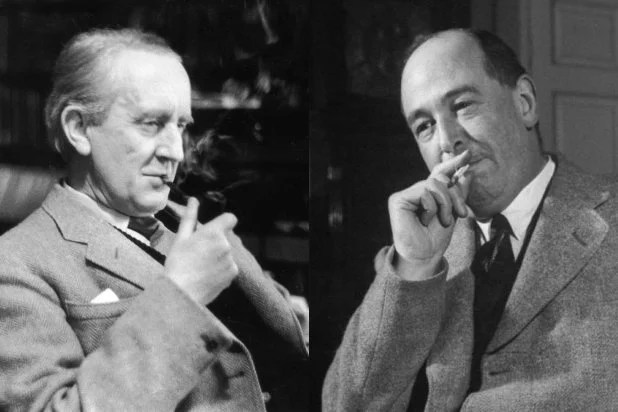
If you’ve read this blog before, you know I talk a lot about my book grandparents—the writers who shaped and influenced me so deeply, and at so young an age, that I’m scarcely even aware of it. It’s like thinking about who taught you to breathe. Two of my book grandparents, the great professors J.R.R. Tolkien and C.S. Lewis, were members of a famous writers group known as the Inklings. Those learned gentlemen and some of their colleagues met regularly, often at an Oxford pub known as The Eagle and Child (or as they affectionately called it, The Bird and Baby), and read aloud to each other from their works in progress. Here, the Narnia stories and The Lord of the Rings were first introduced to the world.
It’s likely impossible to know what influence these authors had on one another’s work, but Diana Pavlac Glyer has nonetheless done a truly remarkable job analyzing (or at least imagining) it. It does seem clear that these remarkable individuals all found something of value in being a part of a group like the Inklings, and it was probably something beyond even the pleasure of spending a lovely evening in a cozy pub with a collection of kindred spirits. I have visited the Eagle and Child a few times, and for me, it is a place of pilgrimage.
I am a great believer in the concept of writers in community. I’m not alone: my pal Zach Steele believes in it so strongly that he formed the Broadleaf Writer’s Association. That same urge is probably at the heart of why I wanted to create Gramarye Media, which is all about community—among both readers and writers. I think all of us long for community. On a more practical note, it’s a reason I’ve spent so much time in pubs, bookstores, and coffee shops trading pages with some of my fellow writers, experiences I continue to treasure. The benefits are countless, and (again) I’m not counting the fact that you get to spend time with fellow writers in a pub, coffeeshop, or bookstore—but don’t discount that.

It’s always a good idea to have a second (or third and fourth) set of eyes on what you’ve written. It’s impossible to catch all of your own typos. What seems crystal to you might not be clear at all to another reader, especially if they aren’t familiar with your genre. They’re more likely to identify words and phrases you overuse and help you spot patches of rough writing or dialogue that doesn’t ring true. They’ll help you catch your continuity errors, logic flaws, plot holes, and both your repetitions and your redundancies. Most of all, they’ll let you know whether or not they care about your characters. If they don’t, they’ll never give a rat’s ass about what’s happening to them. Perhaps most importantly, you have an accountability partner or group of partners. Any writers group worth its salt will mock you mercilessly if you show up without your pages.
More to the point, writing is, almost by definition, a very lonely calling. For that reason alone, community is important. No, more than that. I think it’s critical.
That said, it’s important to choose your writers group wisely—which I suppose is true of any community you decide to be a part of. I’ve worked with critique partners one-one-one and groups both small and large. Smaller is better. I also recommend meeting weekly, or at very least bi-weekly. Otherwise, it’s too easy to lose momentum. You can (and probably will) forge life-long friendships that will ensure long after the group splinters. You can lose some, too.
You want someone—or a group of someones—you can trust to question everything, from word choice to character arc, but never unkindly. You want someone who’s well read, even if (and often especially if) it’s not in your genre. You want someone you can help, and who can also help you. I’m going to mention the word trust again, because it’s important.
I’m a believer in keeping the group small. One or two others is ideal for me; more than four others starts to get unwieldy. Your mileage may vary.
Here’s the but. But. Remember that the only one who truly knows what’s best for your story is you. There’s a lot of bad advice out there. I can’t begin to tell you how many critique partners (and even a few agents) told me that I had to cut the first book I wrote (which will likely wind up being the seventh or eighth to be published) way down. To be fair, at more than 350,000 words, it’s a tad on the longish side—and it’s the first of four. When the book finally sold, my publisher told me, and I quote, “you have to make this longer.” Seriously. Why? It turned out that in trying to hit an arbitrary word count, I’d cut out all the parts that gave the characters a life outside the events of the story. The book is now longer but, somehow, it reads faster.
You’ll probably get a lot of good advice about word count. You will definitely get a lot of bad advice. Stories are as long (or short) as they need to be. The whims of the market don’t dictate that, the needs of the story do.
So how do you spot bad advice? One example, per my own editor and business partner Lou Aronica is this: if someone starts a critical comment with the phrase, “I would” (i.e., “I would have started that scene with the fifth paragraph”), this comment is likely best ignored because the commenter is telling you what they would do rather than what they think is best for the work you created.
Another red flag is advice that seems to focus on the whims of the market at the moment. Lou and I were on a critique panel at a writers conference a few years ago. The other panelists were (as I recall) all literary agents. As we all listened, one writer read a page from a work-in-progress that, without exception, all of the other panelists absolutely trashed. Lou and I loved it. Lou acquired the book for The Story Plant, and it sold very well.
Don’t work with people who don’t treat your work with kindness and respect. Don’t look for people who gush uncritically. If someone says they didn’t enjoy something, they are not wrong. It doesn’t mean your work sucks; it might just mean that they are not your audience. Of, course, it might mean that your work sucks, but that’s okay, too.
One last red flag: if you don’t leave the session uplifted and absolutely on fire to fly back to your keyboard, to keep on writing and make that story even more awesome, you probably haven’t found the partner or community that’s right for you. Don’t stop looking.
If there’s a point, it’s this: surround yourself with community. Trust them. Listen to them. And then make up your own mind. Ignore the bad advice. Ignore some of the good advice if the story tells you so. It is, after all, your story—and only yours. When you walk into your favorite bookstore someday, it’ll be your name—yours—on the cover. (But thank your critique partners, past and present, in the acknowledgments—if only so that you know you’ll sell at least that many copies.)
As always, if you enjoyed this article, please share. I’d be grateful.

 John Adcox: Thoughts on My Author’s Journey
One thought on “On Writers in Community”