
I haven’t conducted any scientifically-valid surveys or research, but I’m nonetheless willing to bet that, at some point in their careers, every budding writer has been taught to avoid clichés like the plague. When a phrase has been used so often that it’s lost all impact, well, it no longer has impact, and the writing comes across as lazy and unoriginal. Those are not great selling points. So let’s grab the bull by the horns and think outside the box so we can figure out how to avoid clichés, which I honestly think has been a problem since the dawn of time.
By the way, I’m not thinking about just overly-familiar phrases. Certain tired plot devices and scenes have also become tropes, which is in my opinion a nice way of saying tired old clichés—like car chases in thrillers and meet-cutes in rom-coms. The thing is, sometimes those clichés are absolutely necessary to the story. Very few rom-coms work if the leads never meet. The trick, I think, is to make them feel fresh.
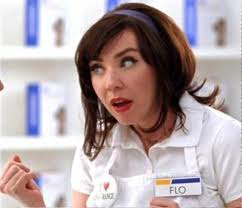
Progressive Insurance has a character named Flo, who wears a crisp white uniform and works in a retail store, where customers come to buy insurance. The store is metaphorical, of course, but it’s apparently been a successful campaign, because those commercials have been running for ages. I don’t remember the setup, but a few years back, Flo said something moderately funny that got a chuckle from the insurance customers. Flo responded with a casual, “I’ll be here all week.” That’s a phrase that’s used often after a humorus line, where the speaker is acting like they’re an act at a comedy club. It is often followed with something like, “be sure to tip your waitress,” or “try the veal.” Ugh. Cliché alert. But the Flo character made it work by leaning to the commercial’s premise: she’s a customer service employee in a retail store. She adds, “Uh, I will. That’s my schedule.” And now the cliché works. It actually works because it’s a cliché, and the punchline assumes we know that.
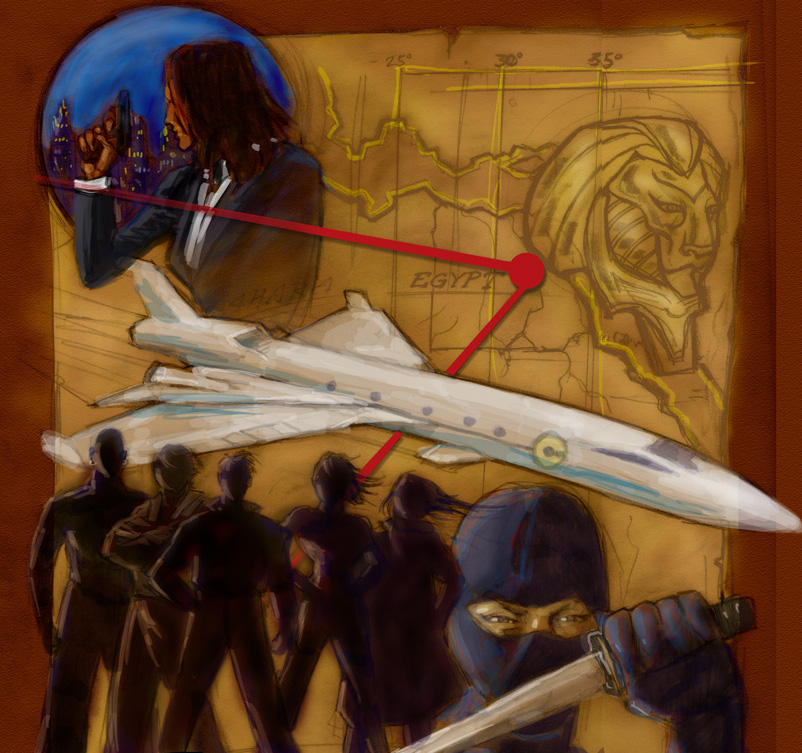
I had a similar issue with a novel I’m working on now called The New Challengers. This book is a modern take on the old pulp heroes like Tarzan, The Shadow, James Bond, and Sir Arthur Conan Doyle’s Professor Challenger (who lends his name to the title). This isn’t a story that avoids clichés; it embraces and celebrates them. It’s my job to make them feel fresh.
At one point, a character actually uses the line, “Tom would take a bullet for any one of us.” Ugh again. Another cliché. The problem is, I really need that sentiment, and since the characters are literally flying into danger, I needed the urgency that comes with the reference to bullets. But it’s still a cliché, and it’s still cringe. I solved the problem (I hope) in sort of the same way that Flo’s writer did. Another character, who is more of a smartass, adds: “That’s true. Of course, he’d probably be the reason we’re getting shot at in the first place, so I guess it sort of evens out.” I’m hoping that the punchline makes the cliché fresh enough that I can use it.
The lesson here is that if you’re going to use a cliché, add something to it to make it fresh.
Several years ago, I attended a writing workshop on writing action scenes. I can’t for the life of me remember the instructor’s name, which is a shame because he was terrific. Anyway, his premise was that it is nigh impossible to come up with a completely new action scene, but you can take a familiar (even stale) one and make it fresh simply by changing the location. The example he used was the climatic duel from High Noon. It’s utterly brilliant … in High Noon. Every time its basic set has been recycled, it’s gotten a bit more stale. Now it’s practically petrified.
The instructor (I really, really wish I could remember his name) showed a way to make that concept fresh. In his reimagining, the two duelists were both parachuting out of a crashing plane. That change used the same basic idea, two men facing off and attempting to shoot one another, but by changing the setting, he changed all the rules and the outcome. The protagonist and the antagonist shot back and forth at each other (the falling, the wind, etc. made aiming a hell of a challenge) until the protagonist ran out of bullets. The bad guy, being a bad guy, had lots of guns and could keep firing. The hero searched frantically, and found his emergency flare gun. He fired it … and hit the bad guy’s parachute. The parachute ignited and the bad guy went down fast.
So. The instructor started with a (very) familiar idea, changed the setting, and made it feel new.
My novel The Star in the East needed a car chase. My heroes needed to move to the next location, and if the bad guys didn’t follow them, the urgency would bled away and my adventure/thriller would become a travelogue. I was writing an Indiana Jones style adventure, not On The Road. The problem is … you’ve seen a million car chases. So have I. So. How to make a car chase fresh?
I started by thinking of all the car chases I’d seen before, from The French Connection to Smokey and the Bandit to Mad Max. I tried to see them in my mind. Every single one I could think of shared one thing in common: they took place outdoors. So my solution was to set my car chase indoors. It starts in a parking garage—motorcycles chasing a tiny Smart Car—and moves into an adjacent office building. I like to hope that made my car chase at least somewhat unique and memorable.
Another idea might be to take something you’ve seen work and make it … not work. You’ve seen cars race up an opening draw bridge and then jump over the gap, right? Well, what if they don’t quite make it? Imagine that the car tries to jump but winds up stuck, with its hood stuck on one side of the bridge and the trunk on the other, all four wheels spinning helplessly in mid air. The bad guys, seeing our hero’s predicament, simply put their car in park, draw their guns, and start climbing. Doom is imminent. Our heroes have no choice but to dive into the water below. Now the bad guys can shoot at them from above. So our heroes try to stay directly beneath the trapped car. But then the bridge starts to open again, meaning the car will soon come crashing down on them from above…. You get the idea.
Again, it’s a familiar idea: the chase that leads to an opening draw bridge and the inevitable jump. But it’s twisted, inverted. The jump doesn’t work, and you have an entirely new action sequence, like a new recipe made from familiar ingredients.
It’s hard, and perhaps impossible, to completely avoid clichés. It is possible, I think, to twist them and make the fresh. As storytellers, that’s the very least we owe our audiences, the people we serve. What are your thoughts?
If you like this post or find it helpful, please share! I would be grateful.

 John Adcox: Thoughts on My Author’s Journey