
As a lover of literature, I am a great fan of the wordsmiths, writers who shape truly elegant prose. It takes a lot to make a novel great, of course. Character is most important, in my opinion, as is the story world. Structure, of course. But lovely writing makes a book sing. The greats, of course—John Steinbeck, Gabriel Garcia Marquez, and Thomas Wolfe, for example, come to mind immediately. I’m also thinking of authors like Catherynne Valente, Mark Helprin (who I think it’s fair to say gets by mostly on the sheer might of his author’s voice alone—Winter’s Tale is one of my very favorite books ever, it just sings, but it’s sure not because of plot, theme, or character), Alice Hoffman, and, of course, the great Ray Bradbury, my friend, mentor, and one of my book grandparents. That’s just to name a very few off the top of my head.
When I’m talking about elegant prose, I’m talking about passages that make you want to just close the book for a moment and stare at the wall, blinking, while you wonder how in the world did the author even do that?
I don’t believe that author’s voice, the art of elegant writing, is something that can be taught. That’s not to say that I don’t think it can be learned. The best way to do that is, of course, to read. If you want to write beautifully, read anything and everything you can get your hands on. Read at least 1000 pages for every one you intend to write. The second best way is to listen. Listen to conversations, how different people express themselves. Listen to the sounds of the world. Listen to music. I’ve always thought that music, that understanding how music works, teaches you meter and flow—keys to elegant writing. I learned at least as much about writing fiction from high school chorus as I did from college writing classes. After that, it’s just work and practice.
When you listen, you begin to notice how some words just sound pretty, words like wistful or incandescent. You notice how some turns of phrase can be nothing short of magnificent, and the words become thunder. You notice how the length of the lines in a song vary, turning notes into music. Sooner or later, you find that you can work the things you’ve noticed into your writing. And if you keep working at it, you find you can’t help it.
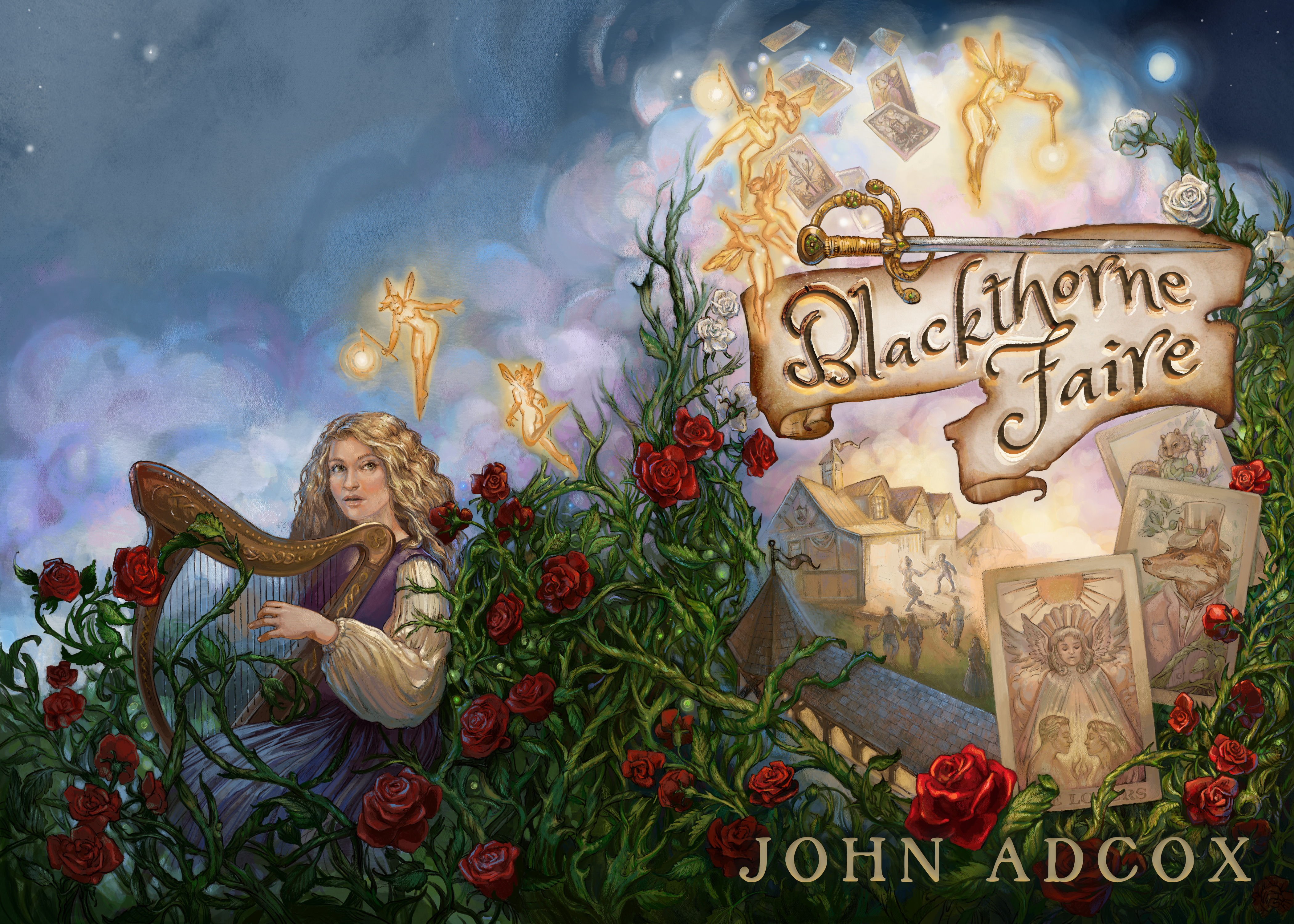
This idea about music influencing writing has been on my mind lately because I recently delivered the final draft of my novel Blackthorne Faire to my publisher. It’s been through the development and copyediting process, and is now with the proofreader. That doesn’t mean I’ve stopped thinking about it. It’s a novel that’s literally about music (note the harper on the cover, above), every bit as much as it’s about adventure, mystery, fantasy, mythology, and romance.
While I was tumbling these thoughts about author’s voice and music around in my head, I stumbled across a YouTube video explaining how Pixar uses music to make you cry in their animated films. I highly recommend giving it a look. You can find the original video here:
Alas, the end was muted for copyright reasons, but you can see that part here:
The point that struck me is this: music enhances the emotion in a film in a way the dialog and images alone can’t. As authors of books, we don’t have that tool. We can come close, of course. I know of a few other authors like my pal Zachary Steele who put together playlists to accompany their books. My friend Lou Aronica is actively composing music to accompany the revised and expanded version of his wonderful novel Blue. Lou is himself a songwriter, so naturally there is a musical quality to his writing.
Of course, none of that works on the page the way it works in film. (Well, maybe it can, but that’s a few months off still.)
So the question I’ve been thinking about is this: what tricks of craft and voice can we novelists use instead? How can we do what music does, using only the sleight of hand trickery of words? How can we bring the impact of music to the written page? I’m not talking about adding lyrics, which two of my book grandparents are famous for: J. R. R. Tolkien and John Myers Myers. I’m talking about the deep waves of feeling that the tunes, weaving of melodies and harmonies, can wake.
There are a number of novels that mention music in the story, and so brilliantly, using only the art of words. I remember encountering a scene in C. S. Lewis’s The Lion, The Witch, and the Wardrobe way back in the second grade. In the scene where Lucy has tea with the faun Mr. Tumnus, he plays music:
Then to cheer himself up he took out from its case on the dresser a strange little flute that looked as if it were made of straw and began to play. And the tune he played made Lucy want to cry and laugh and dance and go to sleep all at the same time.
To this day, I can remember being utterly captivated by that simple passage, and oh, how I longed to hear that tune! I think that’s why Professor Lewis might be the very first of my book grandparents.
J. R. R. Tolkien does something similar near the end of The Return of the King:
And all the host laughed and wept, and in the midst of their merriment and tears the clear voice of the minstrel rose like silver and gold, and all men were hushed. And he sang to them, now in the Elven-tongue, now in the speech of the West, until their hearts, wounded with sweet words, overflowed, and their joy was like swords, and they passed in thought out to regions where pain and delight flow together and tears are the very wine of blessedness.
Professor Tolkien’s writing there is nothing short of magnificent, and the meter of the prose flows almost like poetry or music. If the lines had been broken differently, it might have worked perfectly well as a poem. More, all of the cathartic emotion described is earned utterly through the events of the story that preceded the passage.
Let’s skip forward a few decades, and Patrick Rothfuss publishes another mythopoeic novel, The Name of the Wind. To say that music plays a role in the story is to be guilty of a gross understatement. The lead character, Kvothe, is a musician of remarkable skill. His gift for, and love of, music is probably his single most important defining characteristic. Near the beginning of the story, he is orphaned and lives on the streets of a cruel city, Tarbean. For years, he struggles just to survive, and suffers utterly without his beloved music. The following scene describes what happens when Kvothe finally holds a lute again.
I can honestly say that I was still not really myself. I was only four days away from living on the streets. I was not the same person I had been back in the days of the troupe, but neither was I yet the person you hear about in stories. I had changed because of Tarbean. I had learned many things it would have been easier to live without. But sitting beside the fire, bending over the lute, I felt the hard, unpleasant parts of myself that I had gained in Tarbean crack. Like a clay mold around a now-cool piece of iron they fell away, leaving something clean and hard behind. I sounded the strings, one at a time. When I hit the third it was ever so slightly off and I gave one of the tuning pegs a minute adjustment without thinking.
“Here now, don’t go touching those,” Josn tried to sound casual, “you’ll turn it from true.” But I didn’t really hear him. The singer and all the rest couldn’t have been farther away from me if they’d been at the bottom of the Centhe Sea. I touched the last string and tuned it too, ever so slightly. I made a simple chord and strummed it. It rang soft and true. I moved a finger and the chord went minor in a way that always sounded to me as if the lute were saying sad. moved my hands again and the lute made two chords whispering against each other. Then, without realizing what I was doing, I began to play.
The strings felt strange against my fingers, like reunited friends who have forgotten what they have in common. I played soft and slow, sending notes no farther than the circle of our firelight. Fingers and strings made a careful conversation, as if their dance described the lines of an infatuation.
Then I felt something inside me break and music began to pour out into the quiet. My fingers danced; intricate and quick they spun something gossamer and tremulous into the circle of light our fire had made. The music moved like a spiderweb stirred by a gentle breath, it changed like a leaf twisting as it falls to the ground, and it felt like three years Waterside in Tarbean, with a hollowness inside you and hands that ached from the bitter cold. I don’t know how long I played. It could have been ten minutes or an hour. But my hands weren’t used to the strain. They slipped and the music fell to pieces like a dream on waking.
I looked up to see everyone perfectly motionless, their faces ranging from shock to amazement. Then, as if my gaze had broken some spell, everyone stirred. Roent shifted in his seat. The two mercenaries turned and raised eyebrows at each other. Derrik looked at me as if he had never seen me before. Reta remained frozen, her hand held in front of her mouth. Denna lowered her face into her hands and began to cry in quiet, hopeless sobs. Josn simply stood. His face was stricken and bloodless as if he had been stabbed.
I held out the lute, not knowing whether to thank him or apologize. He took it numbly. After a moment, unable to think of anything to say, I left them sitting by the fire and walked toward the wagons.
It’s interesting to note, I think, that none of these passages actually tell the reader what the music sounds like. The only describe the emotion, the feeling the music inspires, and by doing so, they evoke that emotion simply through the power of the author’s words. And that’s the key, I think. The focus is not so much on the shape and sound of the music, but on the emotion it invokes.
That’s a neat trick, if you can pull it off.
In Blackthorne Faire, music doesn’t just play a key role in the story. In many ways, the story was inspired by music, beginning with the wonderful music I loved so dearly at Renaissance festivals. The mythology of the story was inspired by the poetry of William Butler Yeats, specifically The Stolen Child and The Host of the Air, and by music—the harp tunes of Turlough O’Carolan and the Child Ballads, traditional folk songs from Scotland—the source of much of our knowledge of Celtic myth and folklore. Blackthorne Faire was formed in the womb by music and poetry.
To capture some of that feeling, I tried to match the meter either of one of the Yeats poems or a Child Ballad throughout the book, alternating from one to another section to section, although since I don’t break the lines like a poem, I don’t think anyone will notice, at least not consciously. I do hope, however, that some of the feeling of the music will come through in the prose. It’s in the story’s DNA, as it were.
Beyond that, following the examples of my book grandparents, I tried to focus not on the shape and sounds of the music, but on the emotion it inspires. Here are a couple of examples from Blackthorne Faire:
Jamal led the others back out to the fair. When they reached the main path, Brian came to a stop. A woman playing a harp on a stage nestled in a corner of the crossroads had caught his attention. The others walked on a few steps before they realized Brian wasn’t following them. “You going to stay and listen?” asked Jamal.
Brian didn’t answer. He stood still.
“Apparently so,” Jimmy said, suppressing a grin.
“Then we’ll catch up with you later,” said Jamal. “We’ve gotta hurry. The Rapier Wits are on in a few minutes.”
“We’ll find you,” Jimmy promised.
Brian didn’t notice Jamal and Fiona hurrying away. He listened, and the melody, an old Celtic air, washed over him like gentle rain in a desert. He drank it in like wine, and the strange, unexpected sweetness shook and intoxicated him. The woman pulled notes from the harp’s wire strings, warm and tender, and they reached down deep inside him to wake something, something that had slept, raw and sheltered, for far too long, something that stirred and moved and took wing.
“You like harp music?” Jimmy asked him.
“She’s amazing.”
Jimmy grinned.
The harper was young, younger than Fiona, Brian guessed. And she was lovely. Her hair, long enough to spill down to her waist and into her lap, was the color of fresh, late autumn straw, but shining fingers of light reached through the canopy of trees to turn it to the color of spun gold. Even from a few paces away, Brian saw that her bright eyes were the green of the clear sea near the shoreline. For one single heartbeat, her eyes met his, and Brian felt his heart dance. She smiled, and Brian almost let himself wonder if she had felt it, too, that fleeting moment of connection. Then she looked away.
Another example from later in the book:
Brian and Jimmy stopped where a small crowd had gathered around a performance stage nestled under a tall oak opposite the main entrance to the Half-Moon theatre. The intrusive sounds of the crowd and the festival surrounded them, but Brian didn’t notice. The music of Erin’s harp soothed them all away, a lullaby hushing the noise of the world.
“Brian,” whispered Jimmy, “fortune.”
Brian didn’t answer; he listened, and in the notes and chords he heard more than melody. He heard the sounds of the fair, not as it was, but as Erin knew it. He listened, and the costumes around him seemed no longer puerile or gaudy, but bright and merry, spun from rainbows. Erin played, and Brian heard the music of earth and wood and hidden cities forgotten by time and the march of years, of wild toadstools growing in rings beneath the shadows in the deepest heart of a forest. Shop façades and stage flats vanished like canvas hidden by an artist’s brush, replaced by tall castles and welcoming village squares, alive with people and stories. Brian turned, taking it all in with eyes and mouth wide open. The music shook him, gently, tenderly, like a caress, a touch as soft and full of promise as a first kiss. The tune changed, and Brian heard the sounds of May and the birth of spring, of robins and blue jays, of butterflies and newborns and damp, black earth, pungent and rich. He heard wind and whispers and the buzzing of bumblebees so fat with nectar they could barely flit from flower to blazing flower. He heard the song of streams swelled by melting ice flowing down, down, ever down to join silver rivers leaping over smooth stones.
The music stopped and the crowd’s applause was enthusiastic and appreciative. “My God,” Brian managed at last. “My God, Jimmy, did you hear that?”
“Well of course I heard it. I’m standing right . . . oh.” Jimmy tilted his head as he studied his friend. “No,” he said after a moment. “No, whatever you just heard, I don’t think I heard it.”
I don’t honestly know how well I pulled it off; I am neither a poet nor a composer. More, I don’t really think it’s entirely possible to capture music in prose. I do think it’s possible to remind the reader of music they’ve heard before, and the (so often unexpected) emotions it stirs. Music, after all, inspires connection. It binds us. It’s private emotion shared. I like to think that words can have the same power, that same emotional resonance. Prose driven by the feel and rhythm of music has a new or enhanced power, like adding lyrics to a tune.
In any case, the only tool I have is my own author’s voice—which I owe entirely to all the books I’ve read, the many dear people I’ve shared conversation with, and, of course, all the music I’ve experienced and drank deeply into heart and blood and brain. We are the sum of our experiences and our loves, after all, familiar ingredients spun into something new.
I’d love to know what you think, authors and readers alike.

 John Adcox: Thoughts on My Author’s Journey
I love this topic and the way you’ve presented it here. I think there are a number of ways for music to play a role in the reading experience. I think what you’ve done in Blackthorne Faire might be the toughest, as you’re trying to put music in the reader’s head purely through the description of music the reader doesn’t know. Another path, and one that Zachary Steele uses impressively in Perfectly Normal is to reference songs readers are likely to know to allow those songs to play in the reader’s subconscious while reading the scene. The thing I’m trying to do with Blue is to give readers a moment outside of the text, to use what music does to evoke emotion that is different from what words can do.
So, three different approaches, all seeking to access less-used tools in a storytellers toolbox. I’d love to hear what other writers think about this
Great post. For me, music is a gateway. The last 2 novels were born out of music, with the story following. As to integrating the essence of music into our work, I see music as one of 3 visuals to the flow and composition of words. Music —> dance (like ballet and being light on the page) —> the ebb and flow of the ocean. All things that elicit feeling within. All very much the same at their core. Movement that becomes part of our unconscious mind.
Action driven by long sentences leading to shorter quicker sentences, to me, reaches me the way In The Hall of the Mountain King does, as an example.
I didn’t consider it while reading Blackthorne, but I would imagine there is symmetry in the flow of your words and renaissance music.
Thanks to both of you!
Lovely piece, John. Always enjoy reading your prose.
I’m endlessly fascinated by the way that words can, sometimes, feel like music.
I think of Faramir in Lord of the Rings who says “I do not love the bright sword for its sharpness, nor the arrow for its swiftness, nor the warrior for his glory. I love only that which they defend.”
Again, in Earthsea: “You thought, as a boy, that a mage is one who can do anything. So I thought, once. So did we all. And the truth is that as a man’s real power grows and his knowledge widens, ever the way he can follow grows narrower: until at last he chooses nothing, but does only and wholly what he must do. . . .”
and again, in Kingsolver’s Demon Copperhead: ““I felt the kindliness of the moss, which is all over everywhere once you get out of the made world. God’s flooring. All the kinds, pillowy, pin-cushiony, shag carpet. Gray sticks of moss with red heads like matchsticks. Some tiny dead part of me woke up to the moss and said, Man. Where you been?”
As a musician and a songwriter, my experience of relating music to prose has been odd.
I do, in a few works now, have songs written out in lyric, after the fashion of Tolkien or McCafrey. Those songs are all actual songs. I tried to write songs without melody and chord, just writing in meter as I’ve done in poetic work. But it always felt like lying.
But, now that the music has an actual melody, the world comes alive for me in a way it doesn’t otherwise. I know, as an amateur historian of the genres I write in, and some pieces of that history bleed into the fictional world. It doesn’t show up a ton in the fiction, but it gives me a rudder to steer with.
The radio comes on in the world, and the era of jazz I know Alicrana is in is pre-saxophone domination, pre-electric guitar. The country-folk of one of my main cast, a blue-skinned frog who plays the banjo, is that of a pre-Scruggs style of banjo playing. Banjo played not quite as a guitar, but as accompaniment for the singer.
My Dungeons & Dragons games are as much made of the playlists I create for them as they are of the maps and word documents of lore. I label the playlists around moods, “danger,” “horizons,” and “What kind of school is this? (one of my current games is a very queer and also quite evil magic school)”.
I’ve gotten to the point, when worldbuilding, that I think as much about the musical culture as any other piece to make the world come alive. Music bleeds onto everything else, anyway.
Choirs of people singing together in the way Western Classical music is done requires a level of hierarchy and organization that isn’t present in other places or times.
Drums and flutes can be found almost anywhere. But stringed instruments can tell you a ton about the world that produced them:
Gut strings pulled over frets which must be replaced regularly.
Horsehair for bows.
Tortoise-shell for picks.
Trumpets and the like are made from brass, which requires a level of blacksmithing and alloy-making that speaks to a certain level of technological development.
Back to the idea of words-as-music, that’s still a bit of a mystery to me. Some of it is mechanical, the economy of the sentence, the sound of the words. The way they feel in the mouth.
I think much of it has to do with the whole of the text that came before. We’re building to these moments in the plot, in the exploration of the characters. I don’t know. It’s a thing I ponder a lot.
Beautifully put, Neighbor Willow! Thank you.
This was fantastic to read, John. I could hear the music, not only as I read the excerpts from Lewis, Tolkien, and Rothfuss, but also when I read the excerpts from your own work.
I’m certain that I am not hearing the same music as you, but the emotions that are evoked and shared on the page are real and similar all the same.
May your next walk down the sidewalk be briefly interrupted by the lilting tones of a guitar and the sounds of joy, sadness, and the occasional tink of a coin.
Hope you are having a wonderful day!